

What Lavender and Chamomile Actually Do to Your Nervous System
Most people reach for their phone when stress hits. But, there's something faster.
It doesn't require a download. It doesn't need Wi-Fi. And it works in under 60 seconds—not because it's a hack, but because of the way your brain is wired.
It starts with scent.
Why Scent Hits the Brain Before Anything Else
Every other sense—sight, sound, touch, taste—routes through the thalamus first. That's the brain's relay station. Information goes in, gets filtered, and then gets sent somewhere useful.
Smell skips that entirely.
Olfactory signals travel directly to the amygdala and the hippocampus—the parts of your brain that process emotion and memory. There's no middleman. No filtering. No conscious thought required.
That's why a specific smell can stop you cold before you've even registered what it is. Your nervous system is already responding while your brain is still catching up.
This isn't a metaphor. It's anatomy. And it's exactly why scent is one of the most reliable, underused tools for nervous system regulation.
What Lavender Actually Does
"Lavender is relaxing" is the kind of thing that gets said so often it stops meaning anything.
So let's be more specific.
Lavender—specifically Lavandula species, including Lavandula latifolia—contains active compounds like linalool and linalyl acetate. These have been studied extensively for their effect on the central nervous system.
Here's what the research shows:
It lowers cortisol. Cortisol is your primary stress hormone. Studies have found that inhaling lavender reduces salivary cortisol levels, which is a measurable, physiological indicator of stress reduction, not just a feeling.
It downregulates the sympathetic nervous system. That's the "fight or flight" branch. When it's overactive (which it is, for most people by the end of a regular day), your heart rate is elevated, your muscles are slightly tense, and your body is in low-grade alert mode. Lavender helps shift the balance toward the parasympathetic branch—the "rest and digest" state your body needs to actually recover.
It interacts with GABA receptors. GABA is the brain's primary calming neurotransmitter. Lavender compounds have been shown to modulate GABA activity in ways that reduce anxiety without sedation. It calms the system without shutting it off.
This is why lavender has been used in clinical settings, not just as a nice scent, but as an active intervention.
What Chamomile Adds
Chamomile operates on a different mechanism, and that's the point.
Chamaemelum nobile (Roman chamomile, the variety used in the Tranquility blend) contains apigenin—a compound that binds to benzodiazepine receptors in the brain. Those are the same receptors targeted by certain anti-anxiety medications, though chamomile's effect is much gentler and non-habit-forming.
In practical terms: chamomile doesn't just calm. It specifically addresses anxiety.
Where lavender works on cortisol and the stress response, chamomile works on the anxious thought loop. The rumination. The mental restlessness that keeps you from switching off at the end of the day.
Together, they cover more ground than either one does alone. Lavender handles the body—tension, elevated heart rate, cortisol. Chamomile handles the mind—the racing thoughts, the low-level worry that doesn't have a specific source.
That combination isn't accidental. It's why the two are so consistently paired in serious aromatherapy practice, not just in candle marketing.
The 60-Second Wind-Down Ritual
You don't need a spa. You don't need an hour.
You need a clear signal to your nervous system that the day is over.
Here's the ritual:
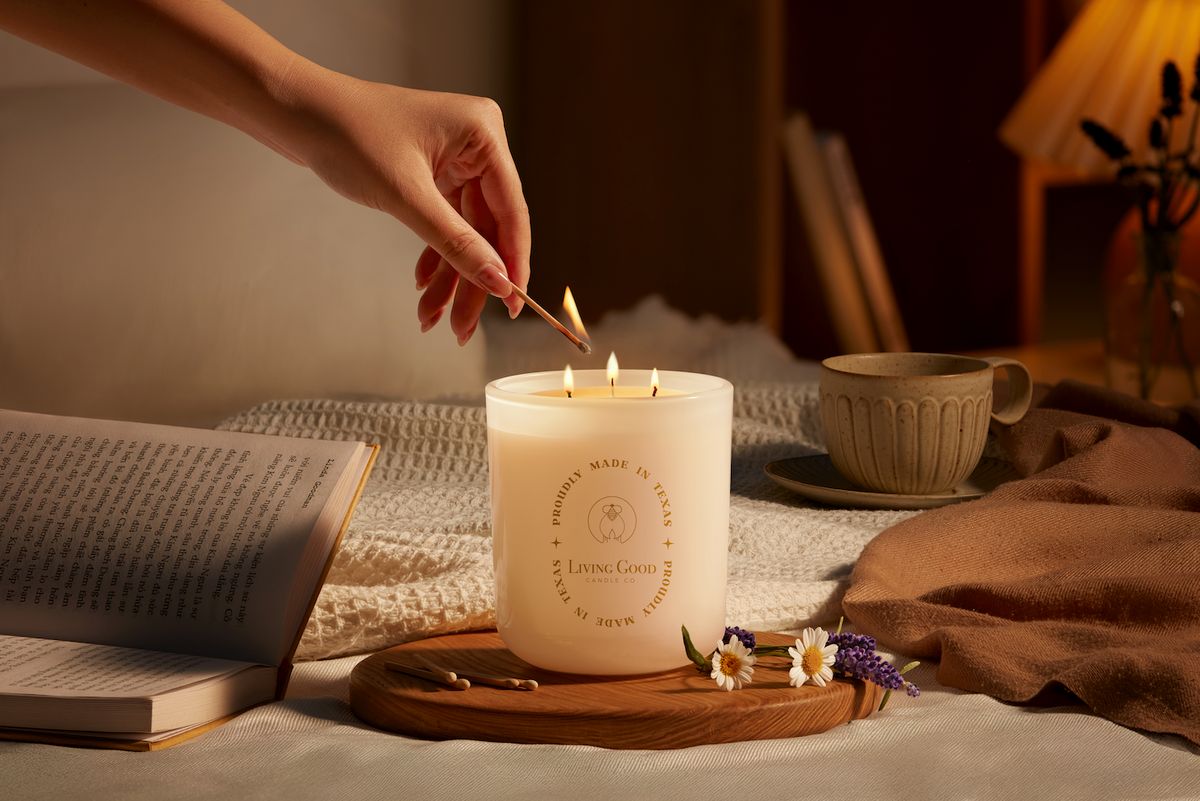
- Light the candle. Not just as ambiance—as intention. The act of lighting it is the beginning of the transition.
- Breathe for 60 seconds before you do anything else. Sit down. Put your phone face-down. Don't open it yet. Just breathe toward the scent. Slow exhale. Let your shoulders drop.
That's it.
The reason this works isn't mystical. When you do this consistently, your nervous system starts to recognize the scent as a cue. The olfactory signal arrives, and your brain, which has been conditioned by repetition, begins the shift to parasympathetic mode before you've even made a conscious effort.
You're essentially training a reflex.
Sixty seconds of intentional breathing, done nightly, compounds. A week in, the effect is faster. A month in, it's almost automatic.
The hardest part is not picking up your phone first. That's not a small ask. It's probably the most important step.
Why the Candle Itself Matters
Not all candles are the same. This part doesn't get talked about enough.
Most mass-market candles, including many marketed as "relaxing" or "spa-quality", are made with paraffin wax and synthetic fragrance. Paraffin is a petroleum byproduct. When burned, it can release volatile organic compounds (VOCs) including benzene and toluene, both of which are known respiratory irritants.
Synthetic fragrance is a catch-all term that can include hundreds of undisclosed chemical compounds. Many contain phthalates—hormones-disrupting chemicals used as fragrance stabilizers that don't need to be disclosed on labels because they fall under trade secret protections.
If you're lighting a candle specifically to help your nervous system downregulate, introducing airborne irritants and endocrine disruptors into your bedroom at the same time is counterproductive at best.
The alternative: beeswax and plant-based oils.
Beeswax burns cleaner than paraffin. It produces minimal soot and no petroleum byproducts. Plant-based fragrance oils and essential oils deliver the aromatic compounds (linalool, apigenin precursors, terpenes) that actually do the physiological work described above.
What you breathe in matters just as much as what you smell.
Try the Tranquility 15oz Candle
The Tranquility 15oz candle from Living Good Candle Co. was formulated with this exact purpose in mind.
The scent is built around lavender and chamomile, both naturally derived, with bergamot to ease anxiety at the surface level, vanilla and tonka to reduce tension in the base, and cedarwood to ground the whole blend.
It's made with 100% American beeswax, sourced from multigenerational beekeepers, and a blend of plant-based oils with zero phthalates, parabens, sulfates, or synthetic stabilizers. Third-party tested by Intertek for burn performance and low soot.
The 15oz jar burns for up to 90 hours.
That's three months of nightly rituals.