
What Moms With Sensitive Kids Are Burning Instead of Paraffin Candles
She switched to non-toxic cleaning products. She switched to cleaner food. Her candle is still made from petroleum.
This isn't a criticism. It's just where most of us are, because candles don't look like a problem. They look like ambiance. They smell nice. They come in beautiful jars and get gifted at holidays and sit on countertops in homes that are otherwise meticulously considered.
Nobody thinks to flip a candle over and read the label. There isn't really a label to read.
That's the problem.
Why candles are the last swap most moms make
When a mom starts cleaning up her home, like really cleaning it up, the way moms who care about this tend to do: she usually starts with what's obvious. She swaps the cleaning spray. She reads food labels. She switches out the plastic. She finds better skincare.
Candles come last, if at all, because they seem passive. They just sit there and look pretty. They're not something her kids are eating or putting on their skin. They're not a cleaning product with a warning label.
But here's the thing: when a candle burns, everything in it goes into the air. The wax, the fragrance, the combustion byproducts, all of it becomes part of the air circulating through her home. The air her kids breathe while they do homework. The air her baby breathes in the next room. The air that, according to the EPA, is already two to five times more polluted indoors than out.
What's in that air depends entirely on what's in the candle.
What paraffin actually releases when it burns
Most mainstream candles, the ones in every big box store, every gift set, every grocery store aisle, are made with paraffin wax. Paraffin is a byproduct of petroleum refining, chemically similar to the fuel in a car engine.
When it burns, it behaves accordingly.
Studies on paraffin combustion have identified the release of volatile organic compounds (VOCs) including benzene and toluene, the same chemicals present in car exhaust and cigarette smoke. Both are classified by the EPA as known or probable human carcinogens. They don't disappear when the candle goes out. They linger in the air, they settle on surfaces, they recirculate through HVAC systems.
For a healthy adult burning a candle occasionally in a well-ventilated room, the exposure is low. But for a child with asthma, allergies, or a respiratory sensitivity, burning in an enclosed space, at floor level where particles settle, for hours at a time, the cumulative exposure is a different calculation.
And synthetic fragrance adds another layer entirely. More on that in a moment.
The 3 ingredients that actually make a candle safe for a home with kids
Not all candles are the same. The ones moms with sensitive kids are switching to share three ingredients in common, and the difference between these and what's in a conventional candle is not subtle.
1. American Beeswax
Beeswax is what candles were made from before petroleum became cheap enough to dominate the market. It's a natural material produced by bees, not a byproduct of refining anything, not processed with chemical bleaches or additives.
When beeswax burns, it doesn't release benzene or toluene. It produces virtually no soot. And unlike paraffin, it doesn't require stabilizers or hardeners to hold its shape.
The sourcing matters here too. Living Good Candle Co. uses pure American beeswax sourced directly from multigenerational U.S. beekeepers, not large distributors, not overseas suppliers with unknown processing standards. Beeswax that doesn't travel through a long supply chain retains more of its natural properties and requires less processing to be usable. That means fewer additives and a cleaner burn.
It's also worth noting: beeswax naturally emits a faint honey scent when burned. Not added fragrance: just the natural characteristic of real wax. That alone tells you something about what's in it.
2. Non-GMO Coconut Oil
Pure beeswax is hard at room temperature, which affects how evenly it burns and how well it throws scent. Coconut oil is added in small amounts to soften the wax, giving it a smoother melt pool, a more consistent burn, and better fragrance dispersion without adding anything synthetic.
That's the whole job. One ingredient, one function, nothing else going on.
Non-GMO matters here for the same reason it matters anywhere: it's a signal of sourcing standards. It means the coconut oil isn't a hidden carrier for pesticide residues or chemical processing. It's just coconut oil, doing what coconut oil does.
3. Plant-Based Oils — Including Essential Oils, Absolutes, and Natural Isolates
This is the ingredient category where most candles fall apart, and where the gap between a clean candle and a conventional one is widest.
In a Living Good Candle Co. candle, the fragrance comes from a blend of essential oils, absolutes, and plant-derived isolates. Every botanical is named and listed by its scientific name: bergamot (Citrus aurantium bergamia), lavender (Lavandula angustifolia), palo santo wood, jasmine absolute (Jasminum grandiflorum). Not "fragrance." Not "natural flavors." Every single source, disclosed.
Essential oils are concentrated plant extracts: the actual aromatic compounds of the plant, steam-distilled or cold-pressed. Absolutes are similar, extracted from delicate botanicals like jasmine that can't survive steam distillation. Natural isolates are individual aromatic molecules derived from plant sources rather than synthesized in a lab.
Together, they produce a scent that is present, complex, and genuinely derived from nature — without the synthetic chemistry hiding inside the word "fragrance."
What "fragrance" on a label actually means
Here's the part that tends to stop moms mid-sentence when they first hear it.
Under US law, "fragrance" is a protected trade secret. Manufacturers are not required to disclose what's in their fragrance formulas. A single word on a candle label can legally represent hundreds of undisclosed chemical compounds, including phthalates (known endocrine disruptors), synthetic musks, and volatile organic compounds that off-gas as the candle burns.
The word "fragrance" is not a red flag in the sense that something terrible is definitely hiding there. It's a red flag in the sense that you simply cannot know what's there. And for a mom who reads food labels specifically because she wants to know what's going into her family's bodies, the idea that she can't know what's going into her family's air should land the same way.
A clean candle doesn't say "fragrance." It says what's in it.
What actually changes when she switches
Moms who make this swap describe the difference the same consistent way.
The black soot ring that used to form on the jar: gone. The dark smudge above where the candle sat on the shelf: gone. The low-grade headache after burning a candle in a closed room for a few hours, the one that was easy to blame on screen time or dehydration: gone.
The air in the room feels different. Not dramatically, not in a way she can point to exactly. Just cleaner. Lighter. The scent is present without being heavy. It doesn't linger in a way that feels artificial. When the candle goes out, the room doesn't smell like it's still burning.
And the thing that matters most for a mom with sensitive kids: she can light it while her daughter is doing homework at the kitchen table, while her toddler is playing on the floor, while her dog is asleep in the corner, and not have to wonder what's going into the air they're all breathing.
That's the switch. It sounds small. It turns out not to be.
The candles worth switching to
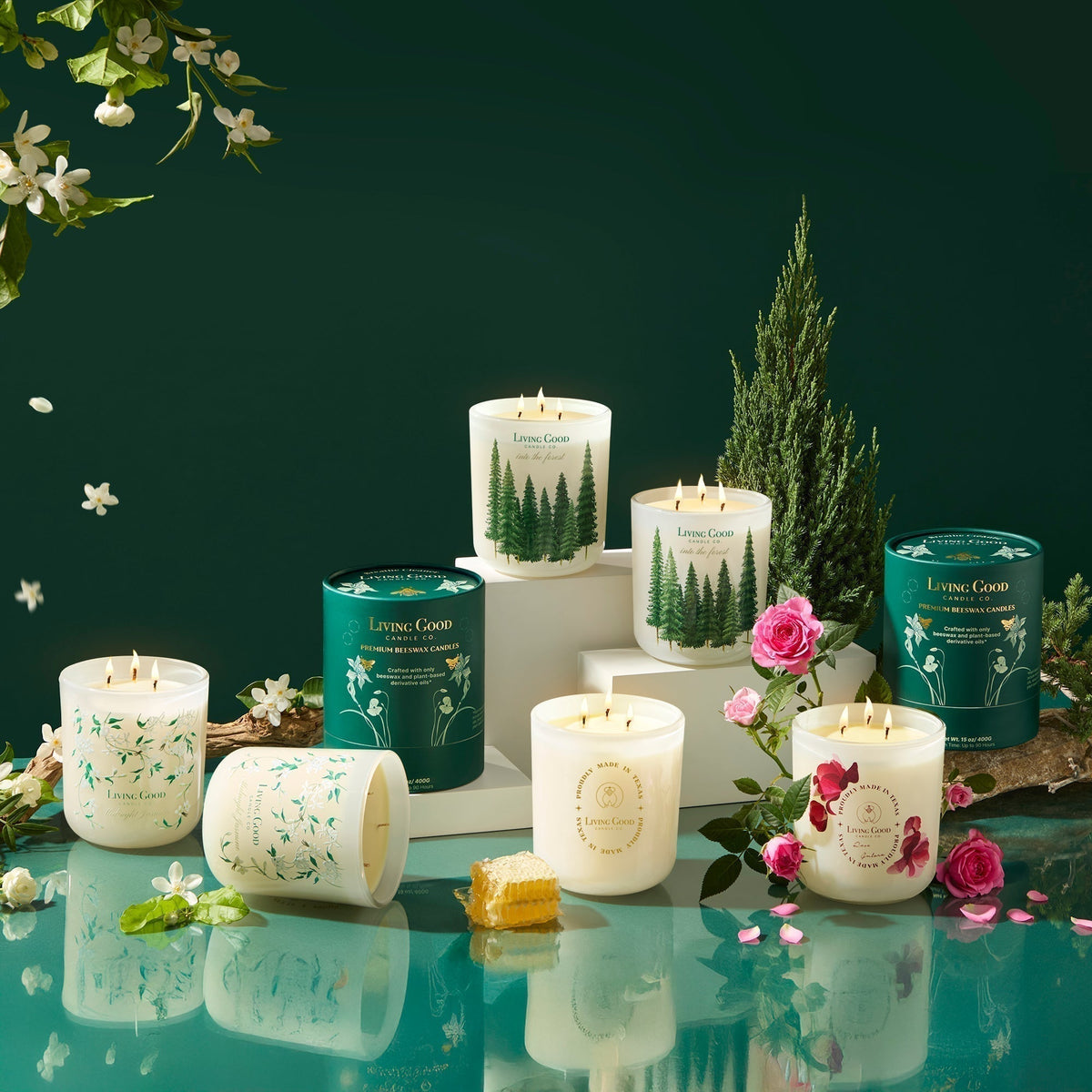
Tranquility and Palo Santo are two of the most-reached-for candles in the Living Good Candle Co. lineup — and both are built entirely on the three-ingredient standard above.
Tranquility — lavender, chamomile, bergamot, vanilla, tonka. The one she lights when the house finally gets quiet and she needs her nervous system to follow.
Palo Santo — bergamot, orange, fig leaf, clove, palo santo wood, cedarwood. The one she lights in the morning before the day starts, or when she needs to reset in the middle of it.
Both are made with pure American beeswax, non-GMO coconut oil, and plant-based oils. Every botanical listed. Third-party tested by Intertek for burn performance and soot output. Nothing she has to look up.
One swap. Real difference.