
Why Moms Are Throwing Out Their Old Candles and Switching to Beeswax
She reads the ingredients on her kids' snacks. She's never read the label on her candle.
And that's not a criticism. It's just how it goes. We've been trained to scrutinize food labels, to flip over the package and check what's actually in there. But candles? They smell nice, they come in pretty jars, and nobody told us to look twice.
Here's the thing: what's burning in that candle is going into the same air her kids are breathing. And for most mainstream candles, the ingredient story isn't a good one.
What's actually in most candles
Walk into any big box store or scroll through any gift guide and you'll find shelves of candles that all have one thing in common: paraffin wax.
Paraffin is a byproduct of petroleum refining, the same process that produces gasoline and diesel fuel. It's cheap, it holds fragrance well, and it's in the vast majority of candles sold in the US. When paraffin burns, it releases a cocktail of volatile organic compounds (VOCs) including benzene and toluene—both of which are classified by the EPA as known or probable human carcinogens.
That's not a wellness blog claim. That's the EPA.
The fragrance problem runs parallel. When a candle label says "fragrance"—and most do—that single word is a legal placeholder for what can be hundreds of undisclosed chemical compounds. Under current US law, fragrance formulas are considered trade secrets, which means manufacturers don't have to tell you what's in them. Phthalates, synthetic musks, and other volatile compounds can all be hiding there, with no requirement to disclose.
So when you light a conventional scented candle in your living room, you're not just burning wax and perfume. You're burning a petroleum byproduct and an unknown chemical blend, releasing their combustion byproducts into your indoor air: the air that circulates through the same rooms where your kids do homework, your baby naps, and your dog sleeps on the floor.
Why it matters more when you have kids and pets at home
Indoor air quality doesn't get nearly as much attention as it deserves. But the EPA estimates that indoor air can be two to five times more polluted than outdoor air — and in some cases, significantly more. The reason is straightforward: we seal our homes, we run our HVAC systems, and we burn things inside without thinking about where those combustion byproducts go.
They go into the air. And they stay there.
For healthy adults, chronic low-level exposure to VOCs can contribute to respiratory irritation, headaches, and fatigue. These are the kind of symptoms that are easy to dismiss as just being tired or having a lot of screen time.
For kids and pets, the stakes are different. Children's lungs are still developing, and pound for pound, they breathe more air than adults do, which means proportionally higher exposure to whatever is in that air. Pets, especially cats and birds, are even more sensitive to airborne compounds. And because kids and animals spend more time low to the ground—closer to floors, closer to where soot and particles settle—their exposure is often higher than ours.
None of this is meant to create panic. Most families burn conventional candles for years without any dramatic health event. But the research on chronic, low-level VOC exposure is what it is. And once you know what's in most mainstream candles, it's hard to unknow it.
What moms are switching to
Once you start looking for it, the answer is pretty consistent: 100% beeswax.
Beeswax is what candles were made from before petroleum became cheap. It's a natural material produced by bees, completely unrelated to fossil fuels or synthetic chemistry. When beeswax burns, it doesn't release benzene or toluene. It produces virtually no soot. And unlike paraffin, there are no combustion byproducts you'd need to look up.
Beeswax candles made with plant-based fragrance oils, not synthetic fragrance, are what a growing number of families are switching to. Not because of a trend, but because once you start reading labels the way you read food labels, the swap makes obvious sense.
What the ingredient list should actually look like
This is the part that requires a little attention, because "natural" and "clean" on a candle label doesn't mean much without specifics. The candle industry isn't regulated the way food is. Greenwashing is common.
Here's what you're actually looking for:
The wax. It should say 100% beeswax—not "beeswax blend," not "natural wax," not a list of waxes that includes paraffin. Just beeswax. At Living Good Candle Co., the beeswax is sourced directly from multigenerational American beekeepers. No large distributors, no overseas supply chains with unknown sourcing standards.
The base. Coconut oil is used to soften the beeswax for a smoother, more even burn and better scent throw. That's it. One ingredient.
The fragrance. This is where most candles fall apart, and where transparency matters most. The fragrance in a clean candle should come from a blend of essential oils, absolutes, and plant-derived isolates. All 100% derived from plants, none synthetic. Every botanical source should be named, not hidden behind the word "fragrance."
The wick. Lead-free cotton. Not zinc-core, not metal-core. Just cotton.
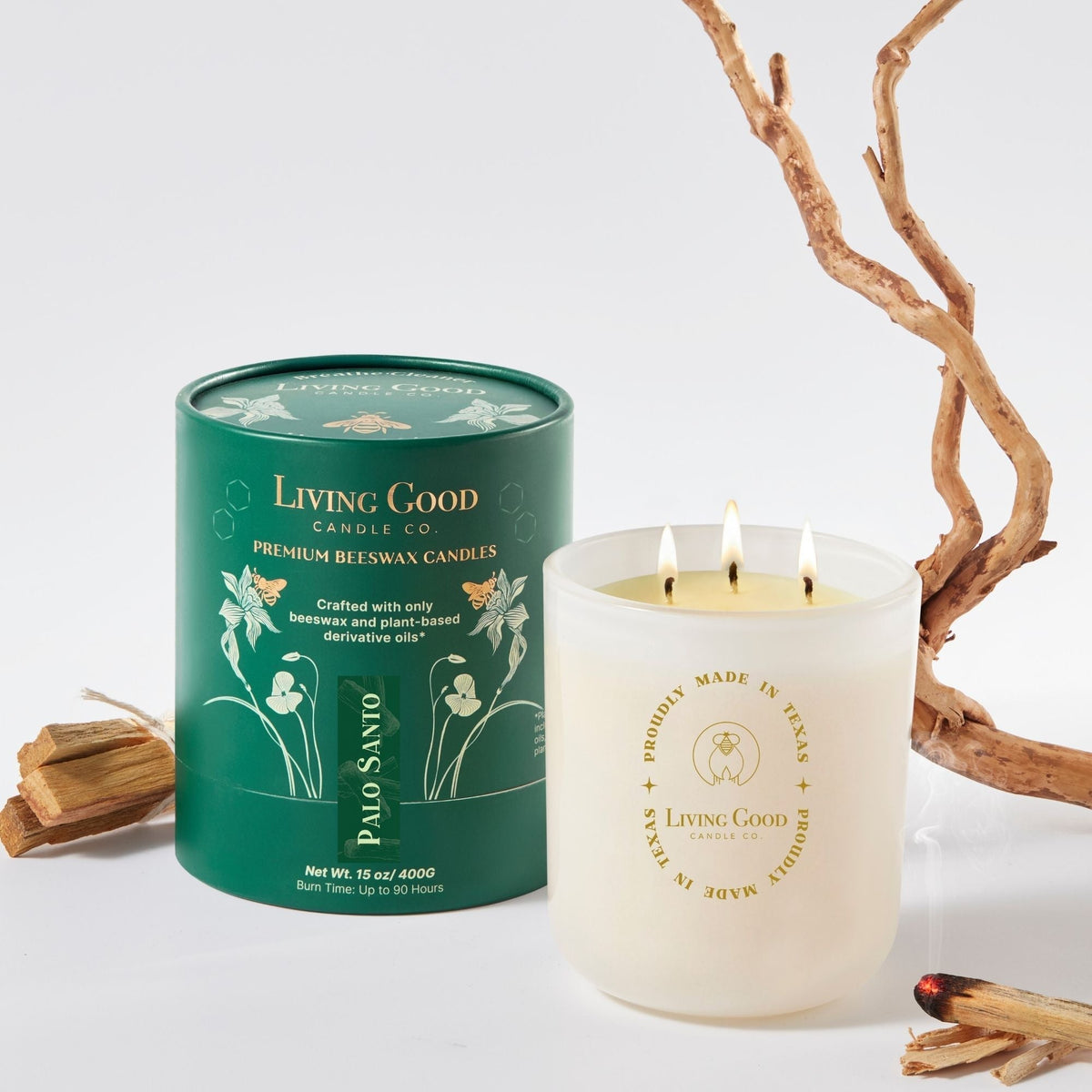
The full ingredient list for the Palo Santo 15 oz reads: Pure American Beeswax, Coconut Oil, and a Blend of Plant-Based Oils, with every botanical listed by its scientific name. Bergamot, orange, fig leaf, clove leaf, palo santo wood, olibanum, cedarwood. No "fragrance." No hidden anything.
That's what a clean candle label looks like.
What actually changes when you switch
Moms who make the swap tend to describe it the same way: the room just feels different.
No black soot ring forming on the jar. No dark residue building up on the wall above where the candle sits. No headache after burning it for a couple of hours in a closed room, the kind of headache that's easy to attribute to something else until you stop burning conventional candles and notice it goes away.
The air doesn't have that thick, artificial sweetness that synthetic fragrance produces. The scent from plant-based oils is cleaner and quieter—present without being heavy.
And the thing that matters most: she can light it while the kids are doing homework at the kitchen table, while the baby is sleeping in the next room, while the dog is curled up on the couch—and not have to think twice about what's going into the air.
That's the switch. It's a small one. And like most small swaps that turn out to actually matter, once you make it, you don't go back.
When you're ready to make the swap
Start with one candle. Read the label the way you'd read a food label. If it says "fragrance" with nothing else, that's the signal to keep looking. If it lists every ingredient by name: wax source, base, each botanical, you're in the right place.
The Palo Santo 15 oz is 90 hours of clean burn: bergamot and orange to open, palo santo and cedarwood to ground, nothing synthetic anywhere in the formula.
One swap. Real difference.