
What Makes Beeswax the Cleanest Burning Wax for Your Home
Most people have had this experience at least once.
You burn a candle you liked the smell of, and a few hours later there is a headache that was not there before. Or you notice a dark ring forming on the inside of the jar. Or you look at the wall above your favorite candle spot and see a faint smudge that was not there six months ago.
These are not coincidences. They are the candle telling you something about what is in it.
What is actually in most candles
The majority of candles sold in the US are made with paraffin wax. Paraffin is a byproduct of petroleum refining, the same industrial process that produces gasoline and diesel fuel. It is cheap, widely available, and holds fragrance well, which is why it became the dominant candle wax once petroleum refining scaled up in the twentieth century.
When paraffin burns, it behaves like the petroleum product it is. Studies on paraffin combustion have identified the release of volatile organic compounds including benzene and toluene. The EPA classifies both as known or probable human carcinogens. They do not disappear when the candle goes out. They remain in indoor air and settle on surfaces over time, which is what causes the dark residue that builds up on walls and ceilings near candles burned regularly over months.
The black soot inside a paraffin jar is the same process in a smaller, more visible form. That residue is combustion byproduct. It is going into the air before it settles anywhere you can see.
What makes beeswax different
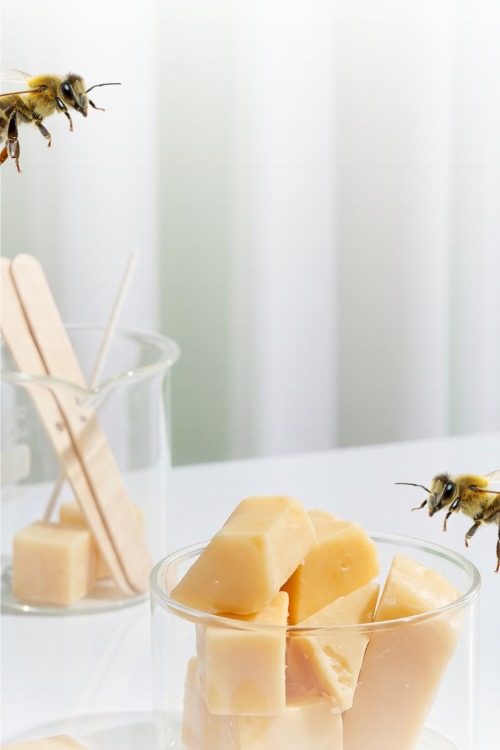
Beeswax is not a petroleum product. It is a natural material produced by bees, completely unrelated to fossil fuel refining, and it has been used for candles for thousands of years before paraffin existed.
The chemistry of beeswax combustion is different from paraffin at a fundamental level.
Beeswax burns at a higher temperature. It melts at around 145 to 147 degrees Fahrenheit, compared to paraffin which melts at 99 to 145 degrees. The higher burn temperature means a more complete combustion of the wax itself, which is a key reason beeswax produces significantly less soot than paraffin.
Beeswax produces virtually no soot. This is the most visible difference for anyone who has switched. The black ring inside the jar does not form. The smudge on the wall above the candle does not appear. The air in the room stays visibly cleaner over the course of a burn.
Beeswax does not require additives. Paraffin candles often include additives and hardeners to improve performance. Beeswax is structurally stable on its own and burns cleanly without anything added to make it work better.
Beeswax has a natural, light honey scent. This is not added fragrance. It is the natural aromatic character of the wax itself, faint and warm, present even in an unscented beeswax candle. It is one of the clearest signals that what you are burning is the real thing.
The sourcing matters too
Not all beeswax is the same, and the supply chain behind it affects both quality and what you are actually getting.
Living Good Candle Co. sources its beeswax directly from multigenerational US beekeepers. Not large distributors. Not overseas suppliers with unknown processing standards. American beekeepers who have been doing this for generations, which means less travel through a long supply chain, less processing required to make the wax usable, and fewer additives introduced along the way.
Beeswax that is handled closer to its source retains more of its natural properties. It does not need to be bleached, deodorized, or treated to be clean. It already is.
What the coconut oil is doing
Every Living Good Candle Co. candle combines American beeswax with non-GMO coconut oil.
Beeswax at room temperature is firm, which affects how evenly it melts and how well it throws scent into a room. Coconut oil softens the wax slightly, which produces a more even melt pool, better scent distribution from the first burn, and a cleaner tunnel-free burn through the life of the candle.
One ingredient, doing one job, with nothing else going on behind it.
What the fragrance is and is not
The fragrance in every Living Good Candle Co. candle comes from plant-based oils: essential oils, absolutes, and natural isolates, all derived from plants, with every botanical listed by name on the label.
This is worth paying attention to because fragrance is where most candles, including many marketed as natural or clean, introduce undisclosed compounds. Under US law, the word "fragrance" on a product label is a protected trade secret. A single word can legally cover hundreds of chemical compounds without any requirement to name them.
When a candle label lists every botanical by its scientific name, there is no room for that kind of ambiguity. What is listed is what is in it.
What you will notice when you switch
The differences between paraffin and beeswax are not dramatic or immediate in most cases. They accumulate over time, which is also how most paraffin-related issues develop in the first place.
Here is what people consistently notice after switching:
The jar stays clean. No black soot ring forming on the inside, no residue building up on the rim.
The walls stay clean. No smudge above the candle spot, even after months of regular burning.
The air feels lighter. This is harder to quantify but consistently reported. The room does not have the heavy, slightly artificial quality that paraffin and synthetic fragrance can produce after a long burn.
The headaches that were easy to attribute to other things go away. Not for everyone, and not a medical claim. But for people who have experienced low-grade headaches after burning conventional candles, this is one of the most commonly reported changes.
The scent is different. Real plant-based fragrance smells different from synthetic fragrance. Not necessarily stronger, but cleaner and more true to the botanical it came from.
Two candles worth starting with
If you are ready to make the switch, two of the most reached-for candles in the Living Good Candle Co. lineup are a good place to begin.
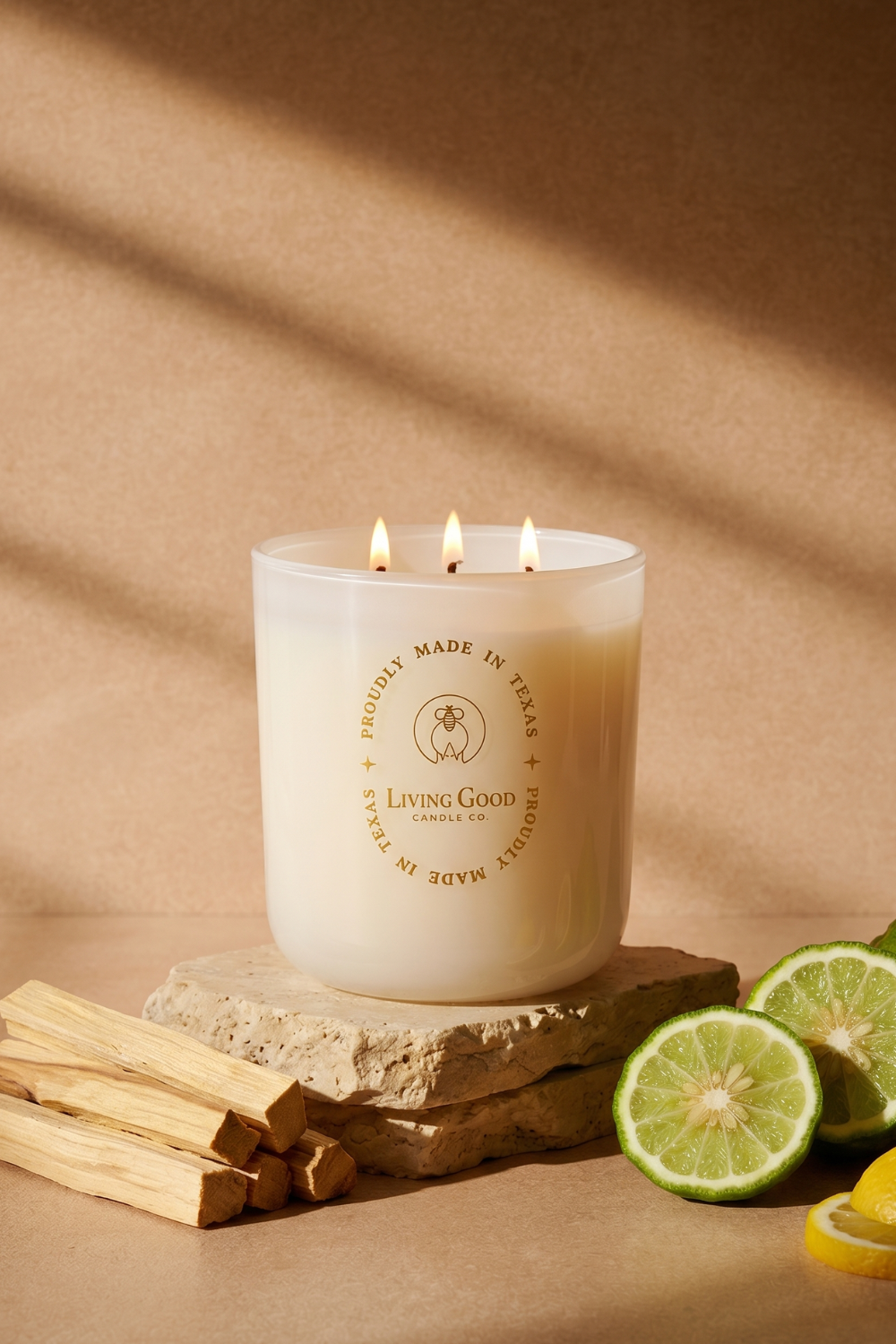
The Palo Santo 3-Wick is bergamot, orange, fig leaf, clove leaf, palo santo wood, olibanum, and cedarwood. Bright at the top, grounded at the base. The candle for the morning, the home office, or any time the room needs to feel more settled.
The Tranquility 3-Wick is lavender, chamomile, bergamot, vanilla, tonka, and cedarwood. The candle for the evening, the bath, the moment the day finally gets quiet.
Both are made with the same three-ingredient foundation: American beeswax, non-GMO coconut oil, and plant-based fragrance oils. Both are third-party tested by Intertek for burn performance and soot output. Both burn for 90 hours.
One switch. Real difference.