
Why Bergamot and Palo Santo Is the Scent Combination You Didn't Know You Needed
Some scent combinations just make sense.
Vanilla and tonka. Lavender and chamomile. Lemon and eucalyptus. These are pairings that feel inevitable once you know them, where each ingredient makes the other better in a way that neither achieves alone.
Bergamot and Palo Santo is that kind of combination. It is just less obvious at first glance, because the two botanicals seem to come from entirely different worlds. One is a citrus fruit from southern Italy. The other is a sacred wood from the forests of South America. On paper, they should not belong together.
In a room, they make complete sense.
What bergamot actually does
Bergamot is a small citrus fruit, Citrus aurantium bergamia, grown primarily in Calabria, Italy. Most people encounter it first as the defining flavor of Earl Grey tea. As an essential oil, it is one of the most well-researched botanicals in aromatherapy.
The primary aromatic compounds in bergamot, linalool and linalyl acetate, are the same compounds found in lavender, which helps explain why bergamot has such a well-documented calming effect despite being a citrus oil. Most citrus oils are energizing. Bergamot is the exception. It lifts mood and reduces anxiety without activating the nervous system in the way that lemon or grapefruit might.
Multiple peer-reviewed studies have documented bergamot's effect on reducing cortisol levels and self-reported feelings of anxiety. A study published in Phytotherapy Research found that bergamot essential oil aromatherapy produced significant reductions in anxiety and fatigue in healthcare workers, a population under sustained high stress.
The practical experience of bergamot in a room is exactly what the research describes. The mood lifts. The tension eases. The air feels brighter without feeling busy.
What Palo Santo actually does
Palo Santo, Bursera graveolens, is a tree native to South America. The name means holy wood in Spanish. It has been used for centuries in Andean spiritual and healing traditions, burned as incense to clear a space, mark a transition, and create a sense of calm presence.
The aromatic compounds in Palo Santo wood include high concentrations of limonene, the same compound present in citrus oils, alongside alpha-terpineol and carvacrol, both of which are associated with calming and grounding effects. Research on Palo Santo essential oil is more limited than bergamot, but the traditional use is extensive and the anecdotal evidence from centuries of ceremonial use is consistent: this wood settles a room and the people in it.
The scent itself is unmistakable. Earthy and resinous with a slight sweetness, a little woody, a little smoky, and warmer than almost any other aromatic wood. It smells ancient in the best sense of that word.
Why they work together
Bergamot and Palo Santo solve different problems and produce a combined effect that neither one achieves alone.
Bergamot by itself can feel light, almost restless in a large space. It brightens without anchoring. Palo Santo by itself can feel heavy in the wrong context, more suited to an evening ritual than a morning moment.
Together, they find a middle state that is genuinely useful across the full day.
The bergamot lifts the Palo Santo. It keeps the resinous, earthy quality of the wood from reading as dark or heavy. The Palo Santo grounds the bergamot. It gives the citrus brightness somewhere to land, adding depth that a solo bergamot candle does not have.
The result is a scent that is simultaneously energizing and calming, bright and grounded. Those qualities are usually in opposition. In this combination, they reinforce each other.
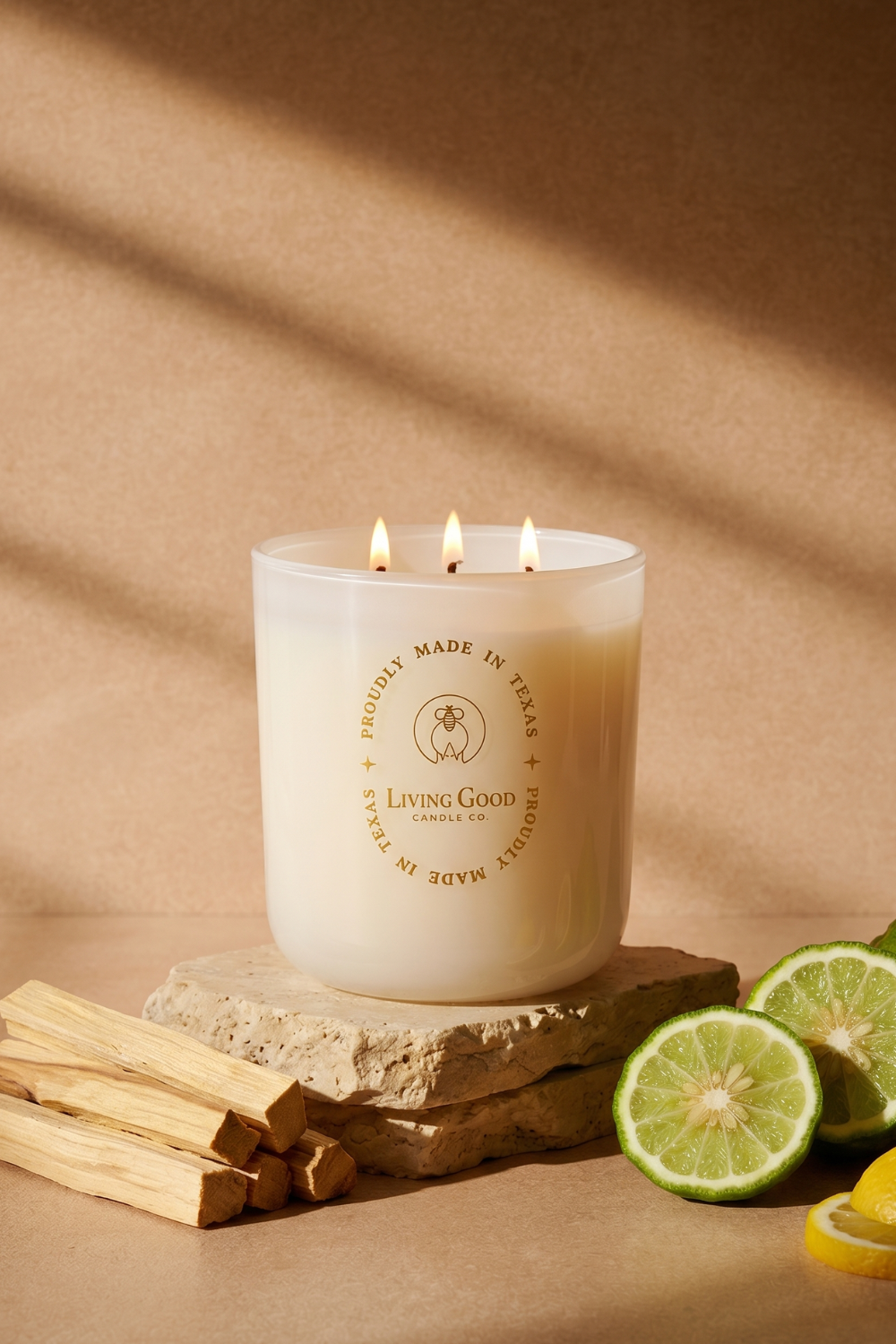
This is why the Palo Santo 3-Wick is described so consistently by customers as a candle for every room and every time of day. It works in the morning because the bergamot is there. It works in the evening because the Palo Santo is there. It works in the home office because the combination keeps the mind clear without pushing it into overdrive.
The full scent profile of the Palo Santo 3-Wick
Bergamot and Palo Santo are the heart of the blend, but the Palo Santo 3-Wick is a six-note fragrance with each element doing something specific.
Bergamot and orange open the candle. Both are citrus, but they read differently. Bergamot has the documented mood-lifting and anxiety-reducing properties described above. Orange is brighter and more straightforwardly cheerful. Together they create a top note that is immediately welcoming.
Fig leaf and clove leaf are the middle of the blend. Fig leaf is green and earthy, a grounding note that begins the transition from the bright citrus opening toward the deeper base. Clove leaf adds warmth and a gentle spice that gives the blend complexity and keeps it from reading as sweet.
Palo Santo wood, olibanum, and cedarwood form the base. Palo Santo wood is the anchor. Olibanum, which is frankincense resin, adds a sacred, spacious quality that has its own history in ritual use and its own research on calming the nervous system. Cedarwood is the deepest note, woody and stable, the last thing you register when you walk into the room and the thing that makes the scent linger.
The arc of the candle, from citrus brightness to earthy depth, is the arc of a good day. It meets you where you are and takes you somewhere quieter.
What it is made with
The Palo Santo 3-Wick is made with pure American beeswax sourced from multigenerational US beekeepers, non-GMO coconut oil, and plant-based fragrance oils with every botanical listed by name.
Beeswax burns cleanly and produces virtually no soot, which matters for a candle you are burning regularly in a home you care about. The three-wick format is designed to fill a full room, not just scent a small corner. Third-party tested by Intertek for burn performance and soot output.
90 hours of burn time. Five-star rated.
The scent combination worth knowing
Bergamot and Palo Santo is not an obvious pairing. It is the kind of combination you encounter, spend a moment trying to place, and then do not want to stop smelling.
That is the mark of a scent that is doing something real. Not just pleasant. Specific. Purposeful. The kind of thing that earns a permanent spot in a home because it keeps working every time it is lit.