
Are Beeswax Candles Safe? What You Should Know Before You Light One
Yes, beeswax candles are safe to burn. That’s the short answer. At Living Good Candle Co., we get this question a lot, usually from someone who’s done a little digging on paraffin and soy and wants to know if beeswax actually holds up to scrutiny. It does. Below, we’ll walk through why, without the hedging you’ll find on a lot of candle sites.
What makes beeswax different from paraffin and soy wax
Beeswax is made by honeybees, not refined in a lab or pressed from a crop. That single fact changes a lot about how it burns.
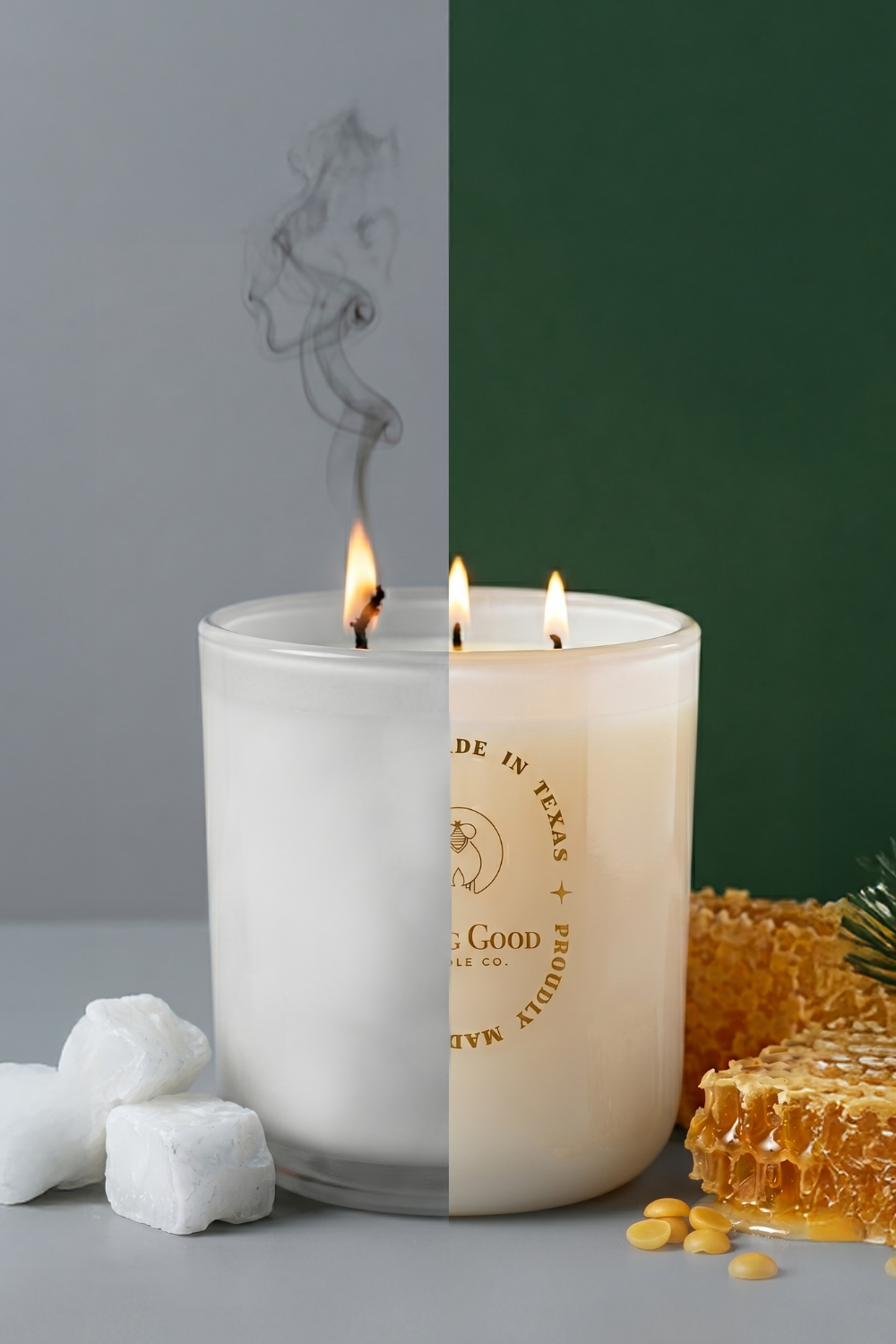
Paraffin is a petroleum byproduct. It’s the most common candle wax on the market because it’s cheap and holds fragrance well, but it’s also the wax most associated with soot buildup and synthetic additives.
Soy wax is a step up. It’s plant-based and burns cleaner than paraffin, but it’s often blended with paraffin or other additives to help it hold shape and scent, and most soy comes from crops grown with pesticides and heavy processing.
Beeswax needs none of that. It’s naturally solid at room temperature, holds its own scent-carrying properties, and doesn’t require the same chemical processing that paraffin does. If you want the fuller breakdown, we’ve laid out the differences side by side in our beeswax vs. soy vs. paraffin comparison .
Is beeswax non-toxic?
Yes. Pure beeswax is non-toxic. It’s a natural substance bees produce to build their hives, and it’s been used in candles for thousands of years, long before synthetic wax existed.
The catch isn’t the beeswax itself. It’s what gets added to it. Some candles labeled “beeswax” are blended with paraffin to cut costs, or scented with synthetic fragrance oils that introduce the very chemicals people are trying to avoid. That’s why it matters to know what’s actually in the candle you’re buying, not just what’s on the front label. We’ll get into how we handle that a little further down.
Are beeswax candles safe to burn around pets?
This is one of the most common questions we hear, especially from cat and dog owners. Cats in particular have more sensitive respiratory systems than we do, and some are more reactive to strong scents than others.
Beeswax on its own is not toxic to cats or dogs. The bigger factor is what a candle is scented with. At Living Good, we scent our candles with Plant Based Oils rather than synthetic fragrance, which gives you more transparency about what’s actually filling the room.
A few good habits regardless of what wax you’re burning: keep the room ventilated, don’t burn candles in small enclosed spaces where a pet sleeps, and watch how your particular pet responds, since every animal is different. If you’ve got a pet with known sensitivities, it’s always worth a quick check with your vet.
Do beeswax candles affect indoor air quality or produce soot?
Beeswax burns notably cleaner than paraffin. Paraffin is petroleum-based, and burning it can release volatile compounds also found in diesel exhaust. Beeswax, especially when the wick is properly sized and trimmed, burns with a smaller, steadier flame and produces very little soot by comparison.
A 2026 emissions study comparing natural and synthetic candles found paraffin candles released meaningfully higher levels of fine particulate matter than natural wax candles under the same conditions.
That doesn’t mean it changes or purifies the air in your home. No candle does that, no matter what the label says. What we can say honestly is that a well-made beeswax candle is one of the cleaner-burning options available, which is a meaningfully different claim.
Are beeswax candles a good option for allergies or sensitivities?
Synthetic fragrance is one of the more common triggers for people with allergies or chemical sensitivities. Research from the University of Washington found that nearly a third of people with asthma also report chemical sensitivity, and more than a third reported irritation specifically from scented products.
If synthetic fragrance is what tends to trigger your allergies or sensitivities, beeswax candles scented with Plant Based Oils are often a better fit than candles made with artificial fragrance blends. Many people who react to typical scented candles find they tolerate beeswax candles more comfortably.
That said, sensitivities are personal. Plant Based Oils are still aromatic, and if you’re sensitive to specific plants or scents, that matters more than the wax type. If you have a known allergy, it’s worth checking the specific oils used before buying, not just assuming “natural” means “safe for you.” We list what’s in every candle we sell so you can make that call yourself.
How Living Good Candle Co. sources and crafts our beeswax candles
We built Living Good Candle Co. around a simple idea: you should be able to know exactly what’s burning in your home. Our candles are made from beeswax and coconut oil, scented with Plant Based Oils, and made with a consistent wick sourced from the same supplier every time, so you’re not getting surprise batch to batch.
We’re not going to tell you our candles are organic, because that’s not a claim we’re able to make honestly, and we’re not going to tell you they purify your air, because no candle does. What we will tell you is what’s actually in the wax, and we’ll keep saying it plainly, because that’s the whole point.
If you want the simplest possible introduction to beeswax, our Bare Beeswax Candle is where we’d start. It’s just beeswax, coconut oil, and nothing else added. We also make a line of scented 3-wick candles using the same Plant Based Oils, for anyone who wants a stronger throw or a specific scent in a bigger room.
Both are built on the same transparency standard. The Bare Beeswax Candle is just the clearest place to see it.
If you’re curious how we compare to other non-toxic options on the market, our team has also broken down why beeswax is the cleanest wax choice and looked closely at whether Yankee Candles are non-toxic , if you want more context before you decide.
See exactly what’s in our candles
If you’ve read this far, you’re probably the kind of person who wants to know what you’re buying before you buy it. That’s exactly who we made this candle for.
Shop the Bare Beeswax Candle and see the full ingredient list for yourself. If you’re looking for something scented for a larger space, our 3-wick candles are made the same way, just with Plant Based Oils added for fragrance.
Sources
- Crunkelton, D., Ilie, M., Seybold, D., Soo, J.-C., & Adhikari, A. (2026). Emission Characterization of Synthetic and Natural Candles in a Residential Environment. Atmosphere, 17(5), 515. https://doi.org/10.3390/atmos17050515
- Caress, S. M., & Steinemann, A. C. (2009). Prevalence of Fragrance Sensitivity in the American Population. Journal of Environmental Health, 71(7), 46–50. http://www.jstor.org/stable/26327879