
Beeswax Essential Oil Candles: What Actually Makes Them Smell?
If you are looking for beeswax essential oil candles, there is one important distinction worth knowing before you buy: a candle can contain essential oils without being scented exclusively with essential oils.
That is how Living Good Candle Co. approaches scent.
Living Good Candle Co. uses plant based oils to scent its beeswax candles. Essential oils can be part of those blends, but they are not the only aromatic ingredients used. Depending on the scent, the blend can also include plant-derived absolutes and isolates.
Why does that matter? Because “made with essential oils” and “made only with essential oils” are not the same thing. Search results for beeswax candles with essential oils include products making both kinds of claims, which makes it especially important to read beyond the front label.
Here is what that distinction means, why Living Good Candle Co. uses the broader term plant based oils, and what to look for when choosing a scented beeswax candle.
What We’ll Cover
- What beeswax essential oil candles actually are
- Whether beeswax needs added fragrance
- Why essential oils are not always the entire scent blend
- What plant based oils means at Living Good Candle Co.
- How complex candle scents are created
- What to look for when comparing scented beeswax candles
- How Living Good Candle Co. approaches fragrance and ingredient transparency
What Are Beeswax Essential Oil Candles?
At its simplest, a beeswax essential oil candle is a beeswax candle that uses essential oils as at least part of its scent.
But that description leaves an important question unanswered: are essential oils the entire scent blend, or just one part of it?
Both types exist.
Some candle makers specifically formulate products using beeswax and essential oils alone. Others combine essential oils with additional aromatic materials to build a particular fragrance. Current search results show that shoppers encounter both approaches when looking for essential oil beeswax candles.
Living Good Candle Co. falls into the second category.
Its candles are made with American beeswax, coconut oil, and plant based oils. Those scent blends can contain essential oils alongside plant-derived absolutes and isolates.
So, yes, Living Good Candle Co. candles can contain essential oils. But describing the entire fragrance system simply as “essential oils” would leave out part of the story.
Does Beeswax Need Essential Oils to Smell?
No. Beeswax does not need added fragrance to make a candle.
Beeswax has a subtle aroma of its own. A candle maker can leave the wax unscented or add aromatic ingredients to create a more distinct fragrance.
That second approach is what creates scented beeswax candles.
The added scent might be built around lavender, citrus, woods, florals, spices, or a combination of aromatic materials. Other fragrances try to recreate something that does not come from one botanical source at all, such as the smell of a cinnamon roll or freshly picked apple.
That is where fragrance formulation becomes more interesting.
Adding one essential oil may work for a straightforward botanical scent. Building a layered scent that smells recognizable from the first light through the rest of the candle can require a more complex blend.
For more on what to consider when choosing the wax itself, Living Good Candle Co.’s beeswax candle buying guide is a useful next read.
Why Aren’t All Scented Beeswax Candles Made Only With Essential Oils?
This is one of the biggest points of confusion around beeswax candles with essential oils.
Essential oils are aromatic materials derived from plants. But not every scent people want in a candle exists as a single essential oil.
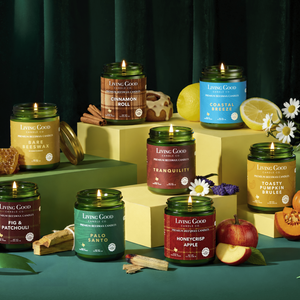
Consider Honeycrisp Apple.
There is no need for a candle called Honeycrisp Apple to be built from one ingredient called “Honeycrisp apple essential oil.” A perfumer can instead combine different plant-derived aromatic materials to build a fragrance that evokes the crisp, juicy character of an apple.
The same principle applies to more complex scent ideas.
A candle inspired by baked goods, a forest, a seasonal memory, or a particular atmosphere may need several aromatic notes working together.
This is why Living Good Candle Co. does not describe its candles as being scented exclusively with essential oils.
Instead, the company uses the broader and more accurate term plant based oils.
What Does “Plant Based Oils” Mean at Living Good Candle Co.?
For Living Good Candle Co., plant based oils describes the complete scent system more accurately than “essential oils.”
The blends can include:
- Essential oils
- Plant-derived absolutes
- Plant-derived isolates
All three can originate from plants, but they are not interchangeable terms.
Essential oils are one category of aromatic plant material. Absolutes are highly concentrated aromatic materials typically used when certain plant scents are better captured through extraction methods other than those commonly used to produce essential oils. Isolates are individual aromatic components derived from plant sources.
That gives a perfumer a broader palette for creating fragrance.
The important distinction is simple: Living Good Candle Co. uses essential oils, but does not use essential oils exclusively. All of the scent oils used by Living Good Candle Co. are plant based.
That wording provides more information than calling the candles essential oil candles and stopping there.
How Are Living Good Candle Co. Beeswax Candles Scented?
Living Good Candle Co. starts with three core components: American beeswax, coconut oil, and plant based oils.
The beeswax forms the foundation of the candle. Coconut oil is incorporated into the wax formulation. The plant based oil blend creates the intended fragrance.
The exact aromatic ingredients can vary from scent to scent because different fragrances require different combinations.
That matters when evaluating natural scented beeswax candles. The scent name on the front of a candle tells you what the candle is designed to smell like. It does not necessarily tell you which aromatic ingredients were used to create that fragrance.
For that, you need the ingredient information.
Living Good Candle Co. publishes scent-specific ingredient information so shoppers can look beyond broad front-label descriptions and better understand what is in a particular candle.
Readers interested in the reasoning behind the scent system can also visit Living Good Candle Co.’s guide to plant based oils in beeswax candles.
Essential Oils vs. Absolutes vs. Plant-Derived Isolates
These terms can sound more complicated than they need to be.
Think of them as different tools available for creating scent.
Essential oils
Essential oils contain volatile aromatic compounds obtained from plant material. They can provide recognizable botanical notes such as citrus, herbs, flowers, and woods.
Absolutes
Absolutes are concentrated aromatic materials obtained through extraction. They can be useful for plant materials whose aromatic character is not always suited to the processes used for traditional essential oils.
Plant-derived isolates
An isolate is a particular aromatic component separated from a plant-derived source. Instead of using the entire aromatic profile of a botanical material, a perfumer can use a particular component for the note it contributes to a blend.
Using these different materials makes it possible to create a wider range of plant-based fragrance profiles.
That does not make one category universally “better” than another. They simply serve different purposes in fragrance formulation.
Are Plant Based Oils the Same as Fragrance Oils?
Not automatically.
Terms such as “fragrance oil,” “natural fragrance,” and “plant based” can be used differently across the candle market. A short phrase on a label does not necessarily tell you everything about a scent formulation.
This is one reason ingredient transparency matters.
Rather than assuming that a candle is made a certain way because of a word on the front of the jar, look for more specific information.
What wax does the candle contain? Is another oil blended with the wax? How does the company describe its scent system? Does it disclose ingredients? What type of wick does it use?
These questions provide more useful information than trying to divide every candle into “good” or “bad” categories based on one marketing term.
Living Good Candle Co. takes the same approach with terms such as “natural” and “non-toxic.” These words can be interpreted broadly, so specific ingredient information is more useful than relying on the label alone.
What Is Left Out of Living Good Candle Co. Candles?
Knowing what goes into a candle is useful. Knowing what is intentionally left out can be useful too.
Living Good Candle Co. candles are formulated without phthalates, parabens, sulfates, heavy metals, GMOs, or formaldehyde. They are also made without stabilizers, colorants, or dyes.
That does not require turning candle shopping into a fear-based exercise.
It is simply information.
Different shoppers prioritize different things. One person may care primarily about the wax. Another may be looking for scented beeswax candles without certain ingredients. Someone else may care most about how the fragrance itself is constructed.
Clear ingredient information lets each person make that decision for themselves.
Are Beeswax Candles With Essential Oils Better?
Not automatically.
A candle containing essential oils is not inherently better simply because the ingredients came from plants. Likewise, “plant based” should not be treated as a scientific guarantee of safety or suitability for every person.
The more useful question is whether the candle matches what you are looking for and whether the maker gives you enough information to understand what you are buying.
If you specifically want a candle scented only with essential oils, look for a company that explicitly says that.
If you want a more complex fragrance while still prioritizing plant-derived scent ingredients, a candle using a broader plant based fragrance system may make more sense.
Neither choice needs to be framed as a moral one.
It comes down to ingredients, fragrance preferences, performance, and transparency.
What Should You Look for When Buying Scented Beeswax Candles?
Start by looking past the biggest words on the label.
If a candle says “beeswax,” find out whether beeswax is the only wax or part of a blend. If it says “made with essential oils,” check whether that means exclusively essential oils or whether they are one component of a larger fragrance blend.
For scented beeswax candles, consider four basic questions:
- What is the wax formulation?
- What creates the fragrance?
- What other ingredients are included or intentionally excluded?
- Does the company provide enough information for you to understand those choices?
The goal is not to find the candle with the longest list of appealing claims.
It is to understand what those claims actually mean.
That is especially important when shopping for beeswax essential oil candles, because “with essential oils” and “only essential oils” can describe two different formulations.
So, Do Beeswax Candles Use Essential Oils?
They can.
Some beeswax essential oil candles are scented exclusively with essential oils. Other scented beeswax candles use essential oils as one part of a broader scent blend.
Living Good Candle Co. takes the latter approach.
Its candles are made with American beeswax, coconut oil, and plant based oils. Those scent blends can include essential oils, but they can also contain plant-derived absolutes and isolates.
That distinction is intentional.
Essential oils are part of the story. They just are not the whole story.
And when it comes to understanding what is actually in a candle, that extra bit of transparency matters more than fitting every fragrance into a single label.